Sunday, June 7, 2015

Concussions and how they effect everyday life.


     My book Fourth Down and Inches was a  fascinating book that described the hardships some athletes have because of head related injuries. My book shares the stories of some athletes lifes after getting many serious head related injuries. My book warns it's readers about the consequences of not treating your injuries correctly.

Nathan Stiles
    My book also describes some stories of ammeter athletes. One story was of a young man named  Nathan Stiles. Who was playing football and felt dizzy after a game. So he took a week of and was back on the field the next week. The week later he was in the game of his life. In the first half alone he thad two touchdowns and rushed for over 100 yards. After, his last touchdown he began to feel dizzy and collapsed. They rushed him to the hospital in a helicopter where he was tended to. But it was to late. Fluid started filling his lungs and at four a.m he passed away. This story warns people that even the smallest injury can be fatal. A group of students are documenting Nathan's story commemorating Nathan's life. You can check this project out at http://www.nathanproject.com.
imageresize?type=attachment&id=41823015&path=120046xenith
The technology that the scientists used to track the amount of force each player received.
     Another chapter my book covers is the story of a group of scientists in Michigan who put sensors in the players helmets and recorded the position that got the most powerful hits. This gave them a useful insight on what happens when a player gets a hard hit. This research is also going to help football to become a safer sport by properly dressing the athletes who play in the positions that get the hardest hits. You can find out more about this research at http://iq.intel.com/making-an-impact-on-head-injuries-the-tech-behind-football-helmets/.
      I would recommend my book to people who like books with a lot of information. My book is a very slow book that on every different chapter it has a different story. If you are the type of reader that likes books that have a fast pace and have lots of action in it I would not recommend this book to you because it tends to lag in speed and action.

Friday, June 5, 2015

Frontier Fever


Frontier Fever
      Looking for a good independent reading book? Maybe a good book to do some research in? This is the book for you. The book Frontier Fever by Elizabeth Van Steenwyk, talks about the history of medicine in America. In particular the book talks about how medicine has evolved and changed through America and the frontier. Frontier Fever includes tons of wacky, gory, superstitious, and just plain weird examples of medical theories and treatments used in the Wild west by the native Americans and settlers. Some of the treatments and theories include spilling warm chicken guts on the patients torso to relieve stomach aches and pains and believing that getting a disease is largely based on your attitude. I think that Elizabeth Van Steenwyk wrote this book for educational and research  purposes mostly but also for people to read for fun. Personally I enjoyed this book as there are lots of specific examples of treatments. This book also delves in to the history outbreaks and epidemics in America. The author talks about how the  various epidemics were caused and how people adapted and fixed them. Relating to history, Steenwyk also provides stories of different doctors, physicians and midwives with particular theories who changed the face of medicine as we know it. While talking about individuals stories, the book includes a story about one of the first female doctors. The doctor was rushing to a patients house where she found that he had cracked his skull open. The doctor quickly took a large coin  out of her pocket, pounded it out flat with a hammer and applied it to the patients skull to fix the crack. In conclusion, I would definitely recommend this book to you if you are looking for some research or just some light reading.
Elizabeth Van Steenwyk


Secrets of Corn

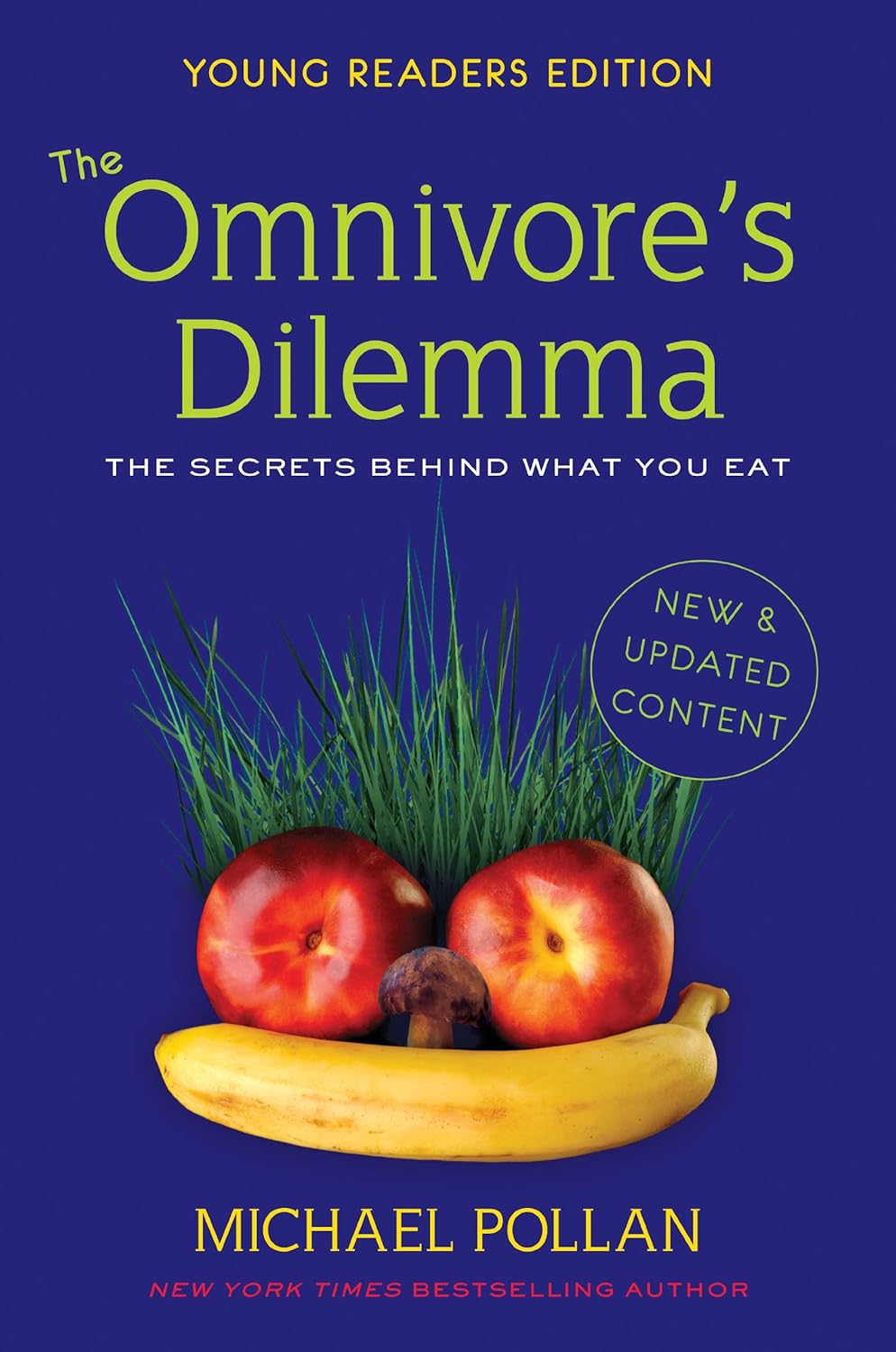
The Omnivore's Dilemma by Michael Pollan
An animal who eats plants and meat is called an omnivore. Humans are naturally omnivores and few by choice don't eat meat ,but that's another story. I read Omnivore's Dilemma by Michael Pollan and I learned about corn. Well that's only thing I was interested by.

There are 2 types of corn. Regular corn that you see on the cob and a type of corn called "number 2 field cThere are 2 types of corn. Regular corn that you see on the cob and a type of corn called "number 2 field corn". This type of corn is in almost everything. Literally. Number 2 field corn is in things like canned fruit from candles. This type of corn is found in fireworks and most soup mixes.

So let's go back in time. Back when all sorts of crops were planted on farms. There was more than 1 farmer on each farm. All the farmers had different jobs to do. Some cared for the horses while other make sure the squash wasn't stepped on. This changed drastically. On a normal American farm, you won't see tractors, squash or multiple people working on the fields. At most you would see cows and soybeans. But as far as the eye can see, corn is everywhere. It pushed out other crops, animals, machines and people.

Corn is changing things. There are no longer farms, there are factories. Even with all the corn farmers are barely getting by. If the spouse of the farmer has a job or if the family has a son or daughter or son that works, they're in luck. Most farmers only get by with the aid of government checks. They have to use things that boost they're corn growth. Things like nitrogen fertilizer and hybrid corn. This stuff isn't good for consumers but it helps farmers out a little. Little fact, nitrogen is in bombs and war weapons and the government has a lot of this left over. The government supplies farms with nitrogen and the farmers put it in the fertilizer. Nitrogen fertilizer helps produce more corn buy it also creates more pollution.

Basically the world isn't the way it used to be. But things change, people change. Farms and farmers alike need money so they get it anyway they can. Corn will continue to push people and crops out of farmers only for one simple reason. Corn is king

The Grand Design By Stephen Hawking

The Book Cover
Stephen Hawking the Author
This book is a great book if you  want to get a overview of our cosmos. It goes over things like string theory quantum theory and the future of our planet. The first chapter goes over basically an overview of our book. I really like Stephen Hawkings writing style because it is easy to  understand yet incredibly interesting. He also makes you want to delve deeper into the subjects he talks about like string theory and quantum theory. It is also a very slim book and I wish in order to make this book even easier to understand he could expand more on some of the more complex topics. I also think that this book is a very good starting place for someone who wants to get started in physics. Quantum theory is basically the theory that electrons and such are almost everywhere at the same time. This books talks extensively about that. Something else it talks about that I wish it would talk about a little bit more is the theory of relativity. This I did not understand as well as I wanted to be able to. Stephen Hawking the author is an amazing person actually he has been diagnosed with ALS. He has been very revolutionary in the world of physics. In conclusion if you are interested in getting into the world of physics and are very interested in this then this is a great place to start. All in all the Grand Design amazingly describes our cosmos and the future and the past. It also discribes how it was formed. Something that I found very interesting was how he explained the history of the people on Earth and how some of the inhabitants were quite advanced in there thinking of the cosmos. Although there were some who had rather far fetched beliefs. This book is amazing if you want to learn anything and everything about whats outside of our world.

Look Me in the Eye, My Life with Asperger's

Disorder, Autism, Asperger's, John Elder Robinson, Look Me in the Eye My Life With Asperger's.


Have you ever wondered about the complexity built into one simple routine when it comes to a person with a mental and/or physical disability? Or maybe you just want to know what it's like to be living "on the spectrum". Well we all know that there is no way of actually knowing what it is like to be living this way unless you are indeed on the spectrum. But with John Elder Robinson's, Look Me in the Eye, we can get a better understanding of someone's life with a metal or physical disability.
The book, Look Me in the Eye, is about the author's life growing up with Asperger Syndrome. Documented from the early age of three, Robinson describes his somewhat challenging childhood in which he was verbally attacked, bullied and pushed a little too hard at times. He also describes how his syndrome effected his home life outside of school. However, in this New York Times best seller, Robinson learns works past the tough and  times, peruse his dreams as a writer, and explain the more positive ends of having Asperger's syndrome. Asperger's Syndrome is a type of autism where people with it have difficulties in social interaction and nonverbal communication. Ways that children and adults express their knowledge and thoughts is usually through technology and intellectual arts. However, in the end I found the book, Look Me in the Eye my Life with Asperger's, to be quite touching, and great for all readers.


John Elder Robinson, about the author:

History of Autism:

The Science Behind Our Favorite Comic Characters


 Did you know that it's possible for Superman to actually fly? Maybe you think about the actual possibility of a man being able to run as fast as the Flash. Well, James Kakalios' book, The Physics of Superheroes, explains everything from the very famous Superman to the more infamous Melter. In this book, he describes how comic book writers for Marvel and DC Comics actually use scientific laws and mathematical equations when describing and writing their comics and characters.

In the first two chapters, Mr. Kakalios describes Superman and how it is scientifically possible for him to have the superpowers and abilities he does. For example, many of his powers are based on the fact that Earth's gravity is much less powerful than that of Krypton, his home planet. Also, the fact that Earth revolves around a yellow sun, rather than Krypton's red sun, is what allows him to bend steel with his bare hands; but, this ability is one of the effects of the Earth's special atmosphere. Here, Mr. Kakalios also describes how Krypton is able to have a gravity that is 15 times as strong as the one on Earth. This is possible because although no normal matter can have a density of 75 grams per centimeter cubed on a planet of Krypton's size and force of gravity, exotic matter can create these conditions. Astronauts have found samples of this type of exotic matter; thus, if  Krypton was the same size of Earth, but had a core of such matter, its density would be 75 grams per centimeter cubed, and its gravity would be 15 times as powerful as Earth's. Having a core of such dense material would also lead to the creation of the matter of a neutron star, which would place massive strains on Krypton's surface, eventually causing the planet to explode; this proves Superman's story to be completely possible.

This is just an example of one of the many characters that Mr. Kakalios explains in his novel. In the later chapters, he discusses the Incredible Hulk, Spiderman, the Flash, Ant Man, Iron Man, and many more. He uses the three laws of thermodynamics, thermal conductivity, Newton's laws of motion, light and its laws, and energy in general to describe how characters received and sustained their powers and abilities.

In comparison to the other scientific books that I've read, this is one of the best. Out of a possible five stars, I would rate the novel with four and a half. It made comic book characters seem more realistic. The scientific facts used to prove the possibility of the characters actually being able to exist were very interesting and helped me learn more about the characters themselves and about science in general. I would recommend this book to  anyone who really loves science and is interested in reading stories that prove things true that were previously seen as only a fantasy.